
Many domestic hot water systems - or more precisely, the circulation pumps in them - run continuously. This causes heat and energy losses and speeds up wear of the pumps and other parts of the system. The answer is control that limits energy losses while keeping comfort.
Let's look at the options - and their drawbacks.
Timer control
One solution is a timer that switches the circulation pump on at set times when hot water is usually needed. The problem is choosing the right hours for each day of the week.
Most users choose Monday to Friday 6-8 am and 4-11 pm, and 7 am-11 pm at weekends. That adds up to 77 hours of pump operation a week, or around 308 hours a month. This is much better than running the pump non-stop, but it still causes large losses.
Temperature sensor
You can use a temperature sensor that measures the temperature of the water returning to the hot water cylinder and switches the pump off when the set temperature is reached. When the temperature drops by a set amount, the pump starts again - even if nobody is using hot water.
The two solutions can be combined. The pump then causes losses only at set times and after a set temperature drop.
Temperature sensor on the cylinder outlet
Another option is a temperature sensor with a control unit on the hot water outlet of the cylinder. It responds to the temperature rise when water is drawn. Unfortunately it reacts with a long delay to the first draws and detects flow less reliably on later ones.
Motion sensors
Circulation can also be controlled by motion sensors in the rooms where hot water is used. When they detect movement, they start the pump. The system can be extended with a return temperature sensor or a timer, but this does not solve the problem of unnecessary starts when someone walks into the bathroom, utility room or kitchen for a reason other than using hot water.
Self-learning controller
Another solution is a controller that spends 14 days learning when the household uses hot water and then runs circulation according to the stored times. When habits change, the settings have to be reset and the program has to learn again.
The trouble is that at home hot water use rarely follows a fixed pattern - because of children, shift work or other changes in daily life. This means frequent resets and relearning. In addition, in some solutions of this kind the control unit is built into the pump, so it cannot be used with a pump from another manufacturer or with a pump already installed in the system.
The ideal solution: a flow sensor
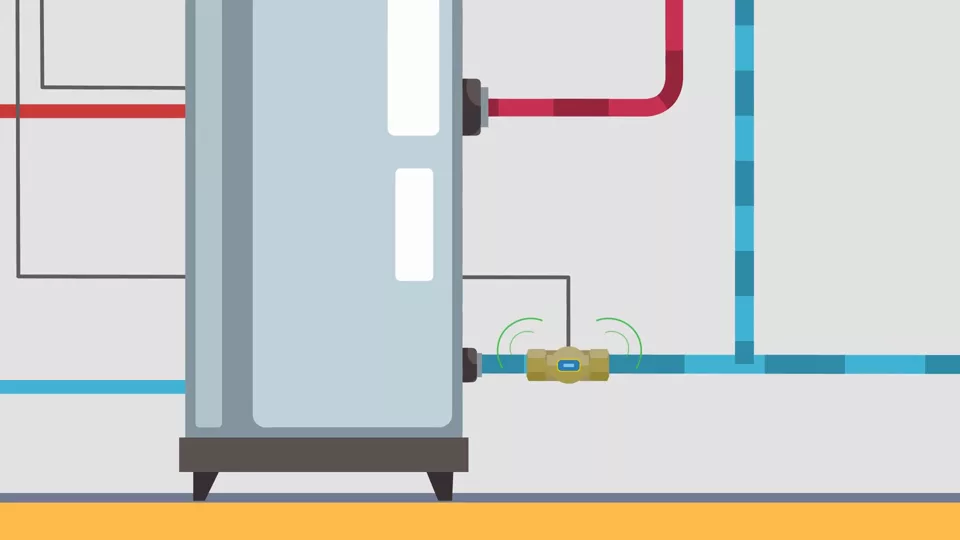
The last solution is a control unit equipped with:
- a water flow sensor,
- an adjustable pump run time,
- a temperature sensor on the circulation return.
The flow sensor tells the controller about every water draw, and the controller starts the hot water circulation pump. The temperature sensor on the circulation pipe measures the temperature of the water returning from the system and switches the pump off when it reaches the required value - running any longer is not needed. If the loop temperature is already high enough, the pump does not start at all.
The flow sensor matches circulation precisely to the needs of everyone in the household, with no need to predict operating hours.
Why does it work in practice?
Modern systems hold little water, and most hot water use starts with a short, small draw that "tells" the system hot water is needed. For example, when we:
- wet a toothbrush before brushing,
- wet the soap before washing our hands,
- rinse a razor,
- wet a sponge before washing the dishes.
Unlike other controllers, a controller with a flow sensor can be used not only with storage water heaters but also with instantaneous water heaters (e.g. a combi boiler). The controller starts working together with the hot water draw, and the part of the water that does not come out of the tap returns to the heating appliance. This speeds up the flow of hot water to the tap, evens out the temperature throughout the system, improves comfort and saves money.
That is why the ECOTECHNIK ET1 hot water circulation controller is a good solution both for fans of circulation and for people who gave it up because it cost too much to run.
See how the ECOTECHNIK ET1 circulation controller works.
Watch the film Buy now